The Living Kitchen: How Fermentation Rituals from Around the World Are Healing Guts — and Minds — That Probiotics Can't Touch
There's a jar of kimchi sitting in someone's grandmother's basement in Seoul right now that has been fermenting for three months. She pressed the cabbage herself, coated every leaf with gochugaru paste using bare hands, and sealed it with the kind of quiet intention that doesn't come with an instruction manual. That kimchi is alive. And so, in a way that modern nutritional science is only beginning to articulate, is the woman who made it.
We've spent the last decade obsessing over our gut microbiome — and rightfully so. The research linking digestive health to mood, immunity, cognitive function, and even chronic disease is genuinely staggering. But somewhere along the way, we reduced this profound biological conversation to a capsule you swallow with your morning coffee. And a growing chorus of researchers, practitioners, and ancestral food revivalists are starting to ask: what did we lose when we did that?
Your Gut Isn't Just a Digestive Organ — It's a Nervous System
Here's something worth sitting with: your gut contains roughly 500 million neurons. It produces about 90% of your body's serotonin. It communicates constantly with your brain through the vagus nerve in what scientists call the gut-brain axis — a bidirectional highway of chemical signals that shapes everything from your anxiety levels to your ability to focus.
Traditional healing systems knew this long before neuroscience named it. Ayurvedic medicine treated digestion as the seat of vitality — agni, or digestive fire, was considered the root of all health. Traditional Chinese Medicine mapped the stomach and spleen meridians to worry and overthinking. Korean hanbang practitioners understood fermented foods not just as nutrition but as medicine for the jeong, a concept encompassing emotional warmth and deep relational wellbeing.
These weren't metaphors. They were observations, refined over thousands of years, that the gut and the mind are not separate systems.
What Fermentation Cultures Actually Understood
Let's get specific, because the traditions here are rich and distinct.
Korea's kimchi culture is perhaps the most well-documented. Kimjang — the communal autumn ritual of making kimchi before winter — was inscribed by UNESCO as an Intangible Cultural Heritage. Families and neighbors gather to prepare hundreds of heads of cabbage together, a practice that is simultaneously agricultural, social, and spiritual. The fermentation process itself is understood as a form of transformation: raw, harsh ingredients becoming something nourishing and complex through time, salt, and care. Korean fermentation philosophy holds that the son-mat — literally "hand taste," the flavor imparted by the maker's hands — is irreplaceable. The microbiome of the person making the kimchi literally becomes part of the food.
Japanese fermentation traditions run even deeper. Miso, which has been made in Japan for over 1,300 years, is produced through a process involving koji mold (Aspergillus oryzae) that transforms soybeans into something with profound umami depth and documented health benefits. But traditional miso-making is not a quick process — it takes months to years, and master brewers speak of listening to the miso, sensing its readiness. Fermentation houses were considered sacred spaces. The microbial cultures living in old wooden fermentation barrels were passed down like heirlooms.
Eastern European traditions offer yet another lens. In Poland, Russia, and Ukraine, lacto-fermented vegetables — sauerkraut, pickled beets, kvass — were winter survival foods and folk medicine simultaneously. Brine was drunk to settle upset stomachs, soothe hangovers, and restore energy after illness. The fermentation crocks were kept in cool cellars and tended regularly. This was not passive storage; it was active relationship.
The common thread across all of these traditions is intentionality. Fermentation was not outsourced. It was a practice — embodied, sensory, relational, and deeply tied to seasonal rhythms.
Why the Ritual Matters as Much as the Microbes
Here's where things get genuinely interesting for modern wellness seekers. A 2021 study published in Cell by researchers at Stanford found that a diet high in fermented foods significantly increased microbiome diversity and decreased inflammatory markers — outperforming even a high-fiber diet in some measures. That's the food doing its work.
But there's a parallel conversation happening in psychoneuroimmunology — the study of how mental states influence immune and gut function — that points to something the Stanford study couldn't fully capture. Chronic stress degrades the gut lining. It disrupts microbiome balance. It impairs the very digestive processes that allow fermented foods to do their job. And what does the act of making fermented food do? It slows you down. It requires sensory engagement — touching, smelling, tasting. It connects you to seasonal time and biological process. It is, in the language of nervous system science, a parasympathetic activity.
In other words, the ritual of fermentation may be doing something that the fermented food alone cannot: actively downregulating your stress response while you prepare the medicine.
That's not something you get from a probiotic capsule.
How to Start Your Own Fermentation Practice
You don't need a kimchi crock or a miso barrel to begin. What you need is intention and a little patience.
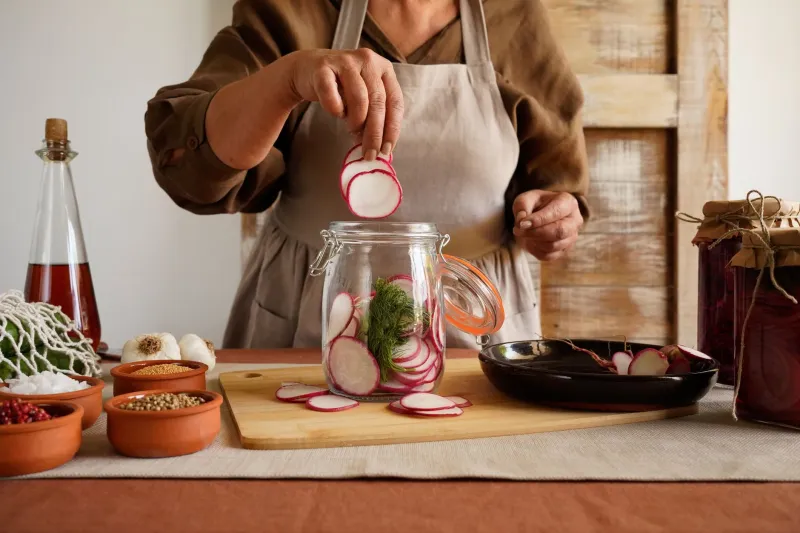
Start with brine ferments. Lacto-fermented vegetables — carrots, cabbage, radishes — require nothing more than vegetables, salt, water, and time. The process is forgiving and fast (many are ready in three to five days). As you pack your jar, try bringing the same quality of attention you'd bring to a meditation practice. Notice the texture of the vegetables, the smell of the brine, the weight of the salt.
Make it seasonal. Traditional fermentation cultures didn't ferment arbitrarily — they worked with what was abundant and what the season demanded. Try aligning your fermentation projects with what's at your local farmers market. This reconnects the practice to the larger ecological rhythms that traditional healing systems considered essential to wellbeing.
Slow down the consumption too. Traditional fermented foods were eaten in small amounts as condiments, not consumed by the bowlful. A tablespoon of live kimchi with a meal, a small cup of miso soup, a few forkfuls of sauerkraut. Consistent, modest, daily.
Consider the relational dimension. Kimjang wasn't powerful just because of the cabbage. It was powerful because of the gathering. If you can make fermented foods with someone else — a partner, a friend, a parent — you're accessing something the solo supplement-taker never will.
The Language Your Gut Has Always Spoken
Your gut is not a passive processing system. It is an ancient, intelligent network that evolved alongside fermented foods, seasonal eating, and the microbiome of other humans and environments. It has been sending signals to your brain your entire life. Most of us have just forgotten how to listen — or we've been handing the conversation off to a capsule and wondering why we still feel off.
The fermentation traditions of Korea, Japan, Eastern Europe, and countless other cultures weren't just preserving food. They were preserving a relationship — between humans and microbes, between intention and nourishment, between the living kitchen and the living body.
That relationship is available to you right now. All it takes is a jar, some salt, and the willingness to slow down long enough to let something transform.