The Conversation Your Gut Stopped Having With Your Brain — And the Ancient Fermentation Rituals That Can Restart It

Imagine your gut and your brain as two old friends who used to write each other long, detailed letters every single day. Then one day — somewhere around the mid-twentieth century, give or take a few decades of industrial food processing — the postal service got privatized, the routes got rerouted, and the letters stopped arriving. The friends are still there. They still want to talk. But the infrastructure between them has been quietly gutted.
That's not a metaphor. That's more or less what's happened to your vagus nerve.
What Neuroscience Is Finally Admitting
The vagus nerve is the longest cranial nerve in your body, running from your brainstem all the way down through your heart, lungs, and digestive tract. For a long time, Western medicine treated it as a one-way messenger — brain sends signals down, body responds. But researchers studying the gut-brain axis have had to do a full pivot on that assumption. It turns out roughly 80 to 90 percent of vagal fibers carry information upward — from the gut to the brain, not the other way around.
Your gut, in other words, is doing most of the talking.
And what it's saying depends almost entirely on who's living in it. The approximately 100 trillion microorganisms that make up your gut microbiome don't just help digest your lunch. They produce neurotransmitters — including about 90 percent of your body's serotonin. They regulate cortisol responses. They influence your capacity for emotional regulation, your baseline anxiety levels, and your resilience under stress. When your microbiome is rich, diverse, and well-fed, the messages going up that vagal highway are essentially: we're okay down here, you can relax. When it's depleted — which, for most Americans eating a standard Western diet, it absolutely is — the signal shifts to something closer to a low-grade alarm that never quite turns off.
The Cultures That Never Lost the Thread
Here's what's striking: the cultures that maintained daily fermented food rituals didn't just happen to eat better. They built fermentation into the architecture of daily life in ways that were inherently ritualistic, communal, and intentional.
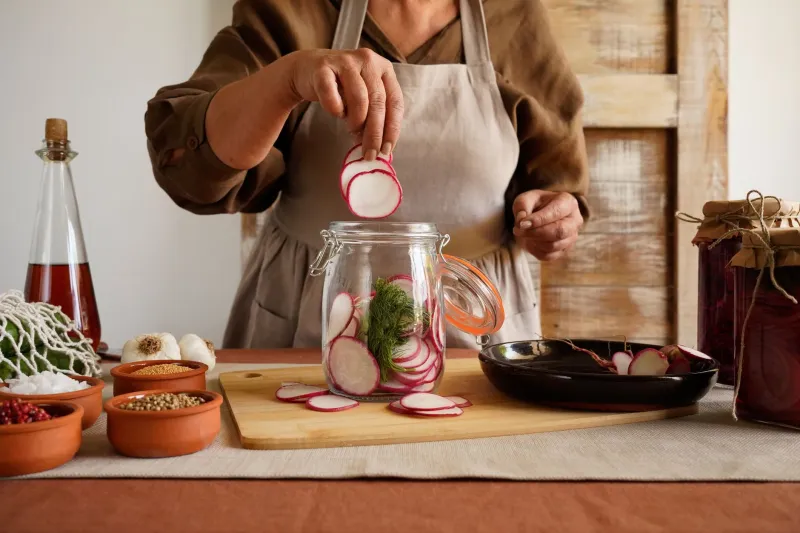
In Korea, kimchi preparation — the salting, the seasoning, the packing of cabbage and radish into earthenware onggi pots — has historically been a community event called kimjang, recognized by UNESCO as an Intangible Cultural Heritage. Families and neighbors would gather for days each autumn, fermenting enough kimchi to last through winter. The practice wasn't just practical. It was relational, seasonal, and deeply tied to a sense of cyclical continuity. The kimchi that emerged from that process wasn't only rich in Lactobacillus strains — it was embedded in a social context that itself reduced stress and reinforced belonging.
In Japan, miso has been made and consumed as part of a morning ritual for over a thousand years. Traditional miso — fermented for months or even years in cedar barrels — contains a complexity of live cultures that bears almost no resemblance to the pasteurized grocery store version most Americans buy. The daily bowl of miso soup wasn't just a meal. It was a grounding practice, a way of beginning the day with something alive, warm, and deeply nourishing to the enteric nervous system.
Kombucha, meanwhile, has roots stretching back to Manchuria in 220 BCE, later spreading through Russia and Eastern Europe where it was brewed in homes as a matter of course — not as a $5 wellness drink, but as a household staple, a living culture passed between neighbors like a gift.
What all of these traditions share is something that modern probiotic supplements, for all their clinical promise, fundamentally lack: context. The ritual of making, sharing, and consuming fermented foods within a community creates a stress-buffering environment that compounds the biochemical benefits of the microbes themselves.
Why Your Probiotic Capsule Isn't Enough
This isn't an argument against probiotic supplements — they have their place, and the research on specific strains for specific conditions is genuinely interesting. But a capsule taken alone at a kitchen counter before rushing out the door is doing maybe 20 percent of what a bowl of traditionally prepared miso soup consumed mindfully at the start of a slow morning might accomplish.
The difference lies partly in diversity. Traditional fermented foods contain dozens or hundreds of microbial strains interacting in complex ways that a single-strain supplement can't replicate. But it also lies in the delivery mechanism — the way ritual, slowness, and intentionality activate the parasympathetic nervous system (the "rest and digest" state) in ways that allow the gut to actually receive what you're giving it. You can't absorb nourishment effectively when your nervous system is in fight-or-flight. The ritual is part of the medicine.
Rebuilding the Channel: A Practical Protocol
You don't need to host a kimjang or brew miso from scratch on day one. What you're building is a practice, and practices begin small.
Start with one living food daily. Choose something you genuinely like — good-quality kimchi, raw sauerkraut (check that it says "raw" and "unpasteurized" on the label), plain kefir, or a traditionally brewed kombucha with visible culture. Introduce it slowly if your gut is unaccustomed to fermented foods; a tablespoon with a meal is enough to start.
Make the moment count. This is where the ritual piece becomes non-negotiable. Before you eat your fermented food, pause. Take three slow breaths. This isn't woo — activating the parasympathetic nervous system through breath literally opens the digestive tract to better absorb what's coming. You're setting the table neurologically before you set it physically.
Feed what you're planting. Probiotics need prebiotics to survive and thrive — the fibrous plant matter that feeds microbial colonies. Garlic, onions, leeks, asparagus, oats, and bananas are all excellent prebiotic sources. Traditional diets that centered fermented foods also tended to be high in these foods, which is not a coincidence.
Consider the communal dimension. If you can make or share fermented foods with another person — even occasionally — you're accessing something that a solo supplement protocol simply cannot offer. The social nervous system and the enteric nervous system are in constant conversation. Nourishing one nourishes the other.
Track mood, not just digestion. The gut-brain axis means that rebuilding your microbiome will likely show up emotionally before it shows up physically. Many people notice shifts in anxiety levels, sleep quality, and emotional resilience within four to six weeks of consistent fermented food consumption. Keep a simple journal. Notice what changes.
The Line Worth Reconnecting
The ancient wisdom embedded in fermentation traditions wasn't operating on a hunch. It was refined over thousands of years of lived experience — people noticing that communities who ate this way were calmer, more resilient, more connected to each other and to the rhythms of the season. The neuroscience is just now arriving at the same address.
Your gut is still trying to text your brain. The infrastructure to receive those messages is still there, dormant but intact. What traditional fermentation practices understood — and what we're slowly remembering — is that rebuilding that channel isn't a clinical intervention. It's a return to ritual. And like all the best rituals, it begins with something small, something alive, and something shared.