What Your Phone Has Done to Your Hands — And the Ancient Palm Rituals Quietly Healing Them
Here's a strange thing to sit with: the average American touches their phone over 2,600 times a day. That's thousands of micro-contacts with glass and aluminum — and almost none of them register as touch in any meaningful sense. We've outsourced our most sensitive organ to a device, and our nervous systems are quietly falling apart because of it.
Your hands contain roughly 17,000 touch receptors and free nerve endings. They're among the most neurologically complex parts of your body. And right now, most of that exquisite sensitivity is being funneled into scrolling, swiping, and tapping — a kind of sensory junk food that stimulates without nourishing.
What gets lost in that bargain isn't just physical. It's relational. Spiritual, even. Because for most of human history, what your hands did — who they held, how they pressed, what they offered — was considered a direct expression of your inner life.
The Neurology of a Numbed Palm
When you swipe a screen, you're activating the touch receptors in your fingertips. But the stimulus is shallow, repetitive, and — crucially — emotionally empty. It doesn't trigger the release of oxytocin. It doesn't slow your heart rate. It doesn't signal safety to your nervous system.
Meaningful touch does all of those things. Research from the Touch Research Institute at the University of Miami has consistently shown that intentional physical contact — particularly hand-to-hand — lowers cortisol, reduces pain perception, and strengthens immune response. Premature infants who receive regular hand contact gain weight faster. Adults who experience more consensual touch report lower rates of anxiety and depression.
But here's what's subtle and worth paying attention to: the quality of touch matters as much as its presence. Distracted touch — the kind where your phone is in your other hand — barely registers. Your nervous system knows the difference between being held and being incidentally grazed.
We've created a world where our hands are perpetually busy and profoundly untouched.
What Ancient Cultures Understood About the Palm
In Ayurvedic tradition, the palms are considered marma points — energetic gateways that connect to the heart, the lungs, and the subtle body. Pressing palm to palm in Anjali mudra (the prayer gesture) wasn't just a polite greeting. It was a momentary circuit-closing between two people's energy fields, an acknowledgment that contact was real and intentional.
In many West African traditions, the handshake is a slow, elaborate, felt exchange — not a quick pump but a layered ritual involving specific grips, finger contacts, and held moments that communicate lineage, respect, and presence. The hand doesn't just greet; it speaks.
Japanese hand-holding rituals within families — particularly between grandparents and grandchildren — have been documented as a form of intergenerational transmission. The stillness of it. The pressure. The warmth. These aren't incidental; they're the medium through which something wordless passes.
In Indigenous healing traditions across the Americas, the laying on of hands — particularly palm-to-palm or palm-to-body — was considered a primary healing modality, not a supplement to it. The healer's hands were understood as instruments of presence, not just physical tools.
All of these traditions share a premise that modern neuroscience is only now catching up to: intentional hand contact is a form of communication that bypasses language entirely.
Three Practices You Can Start This Week
You don't need a ceremony or a teacher to begin restoring what's been lost. You need a partner, some willingness, and the ability to put your phone in another room for ten minutes.
1. The Palm Press (Solo or Partner)
Sit comfortably. Press your palms together in front of your chest — not in a performative prayer pose, but with genuine, even pressure. Close your eyes. Feel the warmth building between your hands. Notice the pulse. Breathe slowly and let your attention sink into the sensation at the center of each palm.
Hold this for three to five minutes. If you're doing this with a partner, press your right palm to their left, fingers pointing upward, and simply hold. No rubbing, no movement. Just contact and breath.
This practice activates the vagus nerve through sustained, gentle pressure and warmth. It's deceptively simple and genuinely regulating.
2. The Slow Handshake Ritual
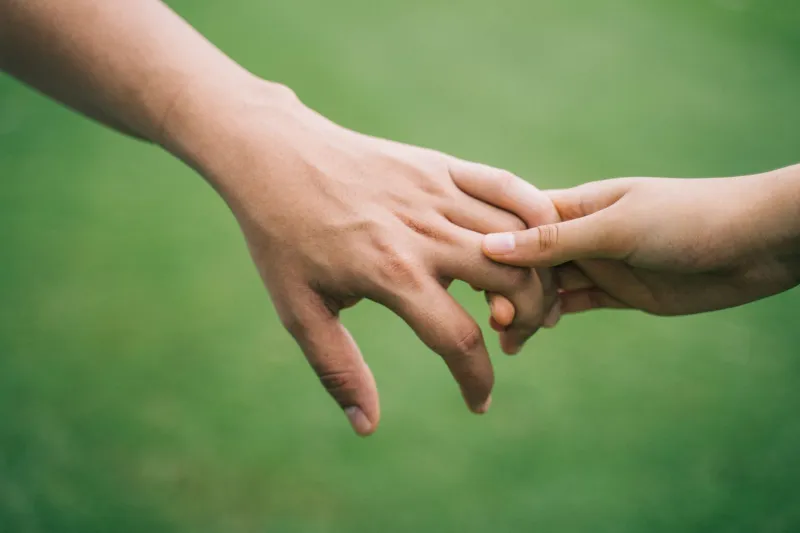
Borrow from West African greeting traditions by transforming how you physically greet the people you love. Instead of the quick hug-and-release, take someone's hand and stay there. Make eye contact. Let the grip soften after the initial clasp. Feel the temperature of their palm. Let a full breath pass before you let go.
This takes about fifteen extra seconds. The neurological impact lasts significantly longer.
3. The Hand Map (Partner Practice)
Sit facing a partner. One person extends both hands, palms up. The other person uses their fingertips to slowly trace the lines, ridges, and contours of those palms — not as massage, but as reading. As genuine curiosity. The person being traced keeps their eyes closed and simply receives.
Switch after five minutes. Afterward, sit quietly together without immediately talking about it.
This practice comes loosely from palmistry traditions — not as fortune-telling, but as a form of witnessed attention. To have your hand studied by someone who cares about you is surprisingly moving. Most of us haven't experienced it since childhood.
Putting the Phone Down Is Only Half the Work
It would be easy to frame this as just another screen-time lecture. But that misses the point. The problem isn't only what we're doing with our hands. It's what we've stopped expecting from them.
We've collectively forgotten that our palms were designed to be in relationship — with soil, with other bodies, with the texture of the world. Screens didn't just steal our attention. They colonized our most relational organ and convinced us the trade was worth it.
The ancient practices above aren't nostalgic. They're corrective. They're asking your nervous system to remember something it already knows: that presence travels through the palm, that warmth is information, that being held — really held — is not a luxury.
It's the oldest medicine your hands have ever known.
And it's waiting for you to pick it back up.