The Skeleton Doesn't Lie: What Ancient Weight-Bearing Rituals Know About Bone Health That Your Calcium Supplement Doesn't
Somewhere along the way, we started treating our bones like infrastructure — something buried beneath the interesting stuff, quietly holding us up until it fails. We pop calcium supplements, maybe add some vitamin D, and call it a day. Then we wonder why osteoporosis diagnoses keep climbing, why stress fractures are showing up in younger and younger people, and why a generation of Americans who eat better than any before them is somehow falling apart at the joints.
Here's what traditional cultures never forgot: bones are alive. They're constantly remodeling, responding, listening. And they speak a language built entirely out of movement, pressure, vibration, and contact with the earth.
The Biology Modern Medicine Is Finally Catching Up To
Bone density isn't a static measurement — it's a conversation. Your skeletal system responds to mechanical stress through a process called mechanotransduction, where physical force literally signals bone cells to rebuild and strengthen. Osteoblasts (the cells that build bone) get activated by load-bearing activity. Without consistent, varied physical stress, they go quiet. Bone resorption outpaces formation, and density quietly bleeds away.
This is not a new discovery. It's just a new name for something indigenous and traditional cultures built entire movement practices around — often without ever naming the mechanism at all.
Researchers studying populations with low rates of osteoporosis have found something curious: it's rarely about calcium intake. Rural communities in parts of West Africa, Southeast Asia, and Central America consume far less dairy than the average American and yet show markedly stronger skeletal density in older adults. The difference? Their daily lives involve sustained, varied, weight-bearing movement — often ritualized, often communal, and often tied to seasonal rhythms.
When Movement Was Sacred, Not Optional
In many traditional cultures, movement wasn't separated from ceremony. It was the ceremony.
Ritual dance in West African traditions — the kind that involves sustained stomping, hip-loading, and full-body percussion — isn't just cultural expression. The repeated, rhythmic impact of feet meeting earth sends mechanical signals up through the skeletal chain. The femur, the pelvis, the spine — all of it gets loaded and unloaded in patterns that modern exercise science would classify as "high-impact osteogenic activity." Except these communities weren't thinking about osteogenic activity. They were honoring ancestors, marking seasons, calling in rain.
The Andean tradition of communal agricultural labor — planting and harvesting in synchronized rhythm, carrying loads, moving on uneven terrain — created a kind of functional weight-bearing that no gym machine has ever replicated. The unpredictability of natural surfaces forces micro-adjustments throughout the skeletal system, stimulating bone remodeling in ways that a flat treadmill simply cannot.
Even ceremonial fasting patterns, practiced across dozens of traditions from Ramadan to Indigenous vision quest protocols, appear to have skeletal implications. Emerging research on time-restricted eating suggests it may influence bone metabolism through pathways tied to insulin sensitivity and inflammatory load — two factors that significantly affect how efficiently the body actually uses the calcium it has.
Earthing: The Grounding Practice Your Bones Might Actually Need
Earthing — the practice of direct skin contact with the ground — has gotten a lot of attention for its effects on inflammation and sleep. But its implications for bone health are less discussed and arguably more interesting.
The earth carries a mild negative electrical charge. When you make direct contact with it — bare feet on soil, grass, sand — your body absorbs free electrons that appear to neutralize oxidative stress and reduce systemic inflammation. Why does that matter for bones? Because chronic inflammation is one of the primary drivers of accelerated bone resorption. Inflammatory cytokines actively signal the body to break down bone tissue faster than it can be rebuilt.
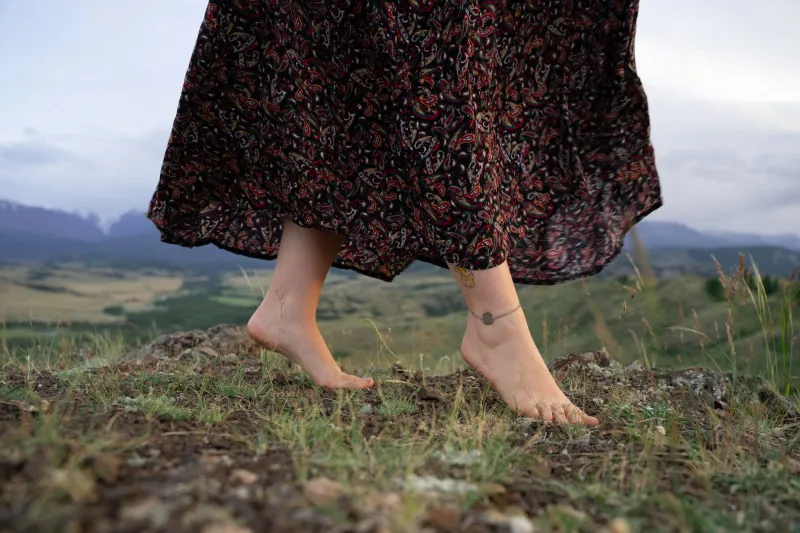
Many traditional cultures built regular earth contact into daily life as a matter of course. Walking barefoot on natural terrain wasn't a wellness practice — it was just how people moved through the world. Sleeping close to the ground, sitting on earth during ceremony, tending gardens with bare hands: all of it maintained a baseline of electrical grounding that modern rubber-soled shoes, concrete floors, and elevated furniture have almost entirely severed.
You don't need to go full barefoot-hiking-at-dawn to access this. Even 20–30 minutes of direct ground contact daily — feet on grass in your backyard, sitting on soil at a park — appears to have measurable effects on inflammatory markers.
How to Build a Weight-Bearing Ritual Practice (Without Joining a Gym)
The goal here isn't to replicate ancient practices wholesale. It's to extract their underlying logic and bring it into a life that looks nothing like theirs. A few principles worth anchoring to:
Vary your terrain. Flat, predictable surfaces are a modern invention. Walk on grass, sand, gravel, or uneven park paths when you can. The micro-adjustments your body makes on natural surfaces create the kind of unpredictable skeletal loading that stimulates bone response.
Add rhythm and percussion. You don't have to be a dancer. Stomping, jumping lightly in place, or even vigorous walking with deliberate heel strikes all create osteogenic impact signals. Traditional cultures used drumming and communal rhythm to sustain this movement for far longer than any individual would on their own — because it stopped feeling like effort and started feeling like joy.
Carry things. Loaded carries — groceries in both hands, a backpack on a walk, even holding a child — are some of the most effective bone-loading activities available. Traditional cultures carried constantly. We've optimized most of that away.
Get on the ground and get back up. Sitting on the floor and rising without using your hands is a deceptively powerful full-body skeletal challenge. Many traditional cultures spent significant time in floor-based postures — squatting, kneeling, cross-legged sitting — which load the hips and spine in ways that chair-based living never does.
Connect to a seasonal rhythm. Traditional movement practices weren't year-round uniform programs. They intensified during harvest seasons, during communal ceremonies, during specific lunar periods. Syncing your most vigorous weight-bearing activity to natural energy cycles — more movement in spring and summer, more restorative practices in fall and winter — mirrors the patterns these cultures followed intuitively.
The Supplement Isn't the Problem — The Missing Ritual Is
None of this is an argument against calcium or vitamin D. Deficiencies are real and supplementation matters. But supplements can't do the work that movement does. They can provide the raw materials; they can't tell the body to build.
Your skeleton is waiting for a signal. It's been waiting, maybe for years, for the kind of varied, rhythmic, earth-connected movement that human bodies evolved expecting. The ancient cultures that built ritual around that movement weren't being mystical — or at least, not only mystical. They were doing something profoundly practical: they were keeping their bones in the conversation.
Start there. Get on the ground. Stomp a little. Carry something. Take your shoes off and stand in the grass. Your skeleton will know exactly what to do with it.