Your Nose Knows More Than Your Therapist: The Ancient Scent Rituals That Are Actually Rewiring Your Brain
Let's be honest about your candle collection for a second.
You've got the one that smells like a forest after rain. Maybe a bergamot-and-cedar situation on the nightstand. Possibly a whole shelf of them, rotated by season or mood. And there's nothing wrong with that — scent is genuinely powerful, and surrounding yourself with things that smell good is a reasonable life choice.
But here's what the $10 billion aromatherapy industry doesn't want you to sit with: passive scent consumption and intentional scent ritual are not even close to the same thing. One makes your apartment smell nice. The other can — and ancient cultures believed this without hesitation — literally reshape how your brain processes memory, grief, fear, and spiritual connection.
The neuroscience is starting to back them up.
Why Smell Is the Oldest Language Your Brain Speaks
Of all your senses, olfaction is the only one with a direct, unfiltered line to the limbic system — the emotional and memory headquarters of your brain. When you see something, hear something, or touch something, that signal travels through the thalamus first, getting processed and sorted before it reaches the parts of you that feel things. Smell skips that middleman entirely.
A scent molecule hits your olfactory receptors and goes straight to the amygdala and hippocampus. That's why catching a whiff of your grandmother's kitchen can drop you into a full-body memory before your conscious mind even registers what's happening. It's not nostalgia — it's neurology.
This direct pathway is what ancient ritual traditions understood intuitively, long before anyone had a word for the limbic system. They weren't just making temples smell nice. They were engineering neurological states.
Kōdō: The Japanese Art of Listening to Incense
In Japan, the centuries-old practice of kōdō — which translates roughly to "the way of incense" — is considered one of the three classical arts of refinement, alongside ikebana (flower arranging) and the tea ceremony. And the language around it is telling: practitioners don't say they smell the incense. They say they listen to it.
Kōdō ceremonies involve burning small pieces of precious agarwood (oud) over heated charcoal, passing the incense cup in silence, and receiving the scent with full, deliberate attention. There are named pieces, named moods, named associations — often drawn from classical poetry. The whole practice is structured around the idea that scent is a carrier of meaning, not just sensation.
What's happening neurologically during this kind of slow, intentional olfactory attention? Researchers studying mindfulness and sensory focus have found that deliberate, present-moment engagement with a sensory experience significantly amplifies its neurological impact — deepening memory encoding, activating parasympathetic (rest-and-digest) nervous system responses, and even influencing emotional regulation pathways. The ritual container isn't decoration. It's the mechanism.
Agarbatti and the Sacred Smoke of the Indian Subcontinent
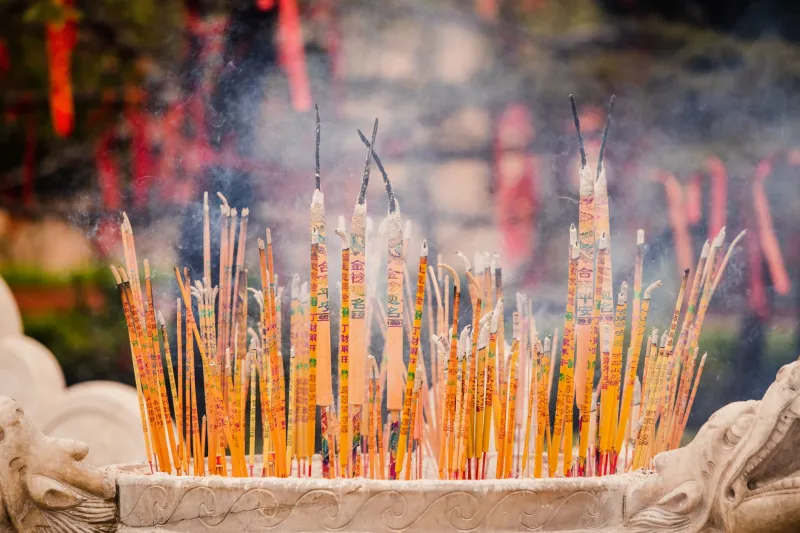
In Indian traditions, agarbatti — incense sticks — are woven into daily devotional life in ways that go far beyond ambiance. The burning of specific resins, woods, and floral compounds during puja (prayer and offering rituals) is understood to purify the space, honor the divine, and prepare the mind and body for communion with something larger than ordinary daily consciousness.
The specific materials matter enormously. Sandalwood for calming and focus. Jasmine for opening the heart. Camphor for clearing energetic debris. These aren't arbitrary — they reflect generations of accumulated observation about how specific scent compounds affect human states. Modern research on compounds like alpha-santalol (found in sandalwood) has confirmed sedative and anxiolytic effects. The tradition got there first.
But beyond the chemistry, what Indian incense traditions preserve is the relational quality of scent ritual. You're not burning incense to relax. You're burning it as an act of offering, of attention, of showing up to something sacred. That framing changes everything about how the brain receives the experience.
Smudging and the Indigenous Wisdom of Smoke
Indigenous smudging practices across North America — using bundles of sage, cedar, sweetgrass, or palo santo depending on the nation and tradition — represent some of the most widely appropriated and most widely misunderstood healing practices in the modern wellness space.
When these practices are reduced to "burning sage to clear bad vibes," something essential gets lost. Traditional smudging is ceremonial. It involves specific prayers, specific intentions, specific protocols for how the smoke is moved and where it travels. The person performing the ritual is not passively enjoying a scent — they are actively participating in a process of cleansing, protection, and connection to ancestral lineage.
Research published in the Journal of Ethnopharmacology has confirmed that burning certain medicinal plants does have measurable antimicrobial effects on air quality. But the deeper work — the psychological and spiritual work — happens through the intentionality of the ceremony itself. The scent is the vehicle. The ritual is the destination.
What Your Candle Is Actually Missing
Here's the core problem with how most of us in the US engage with scent-based wellness products: we treat them as passive environmental modifiers rather than active ritual tools.
You light a candle. You go back to scrolling. The scent drifts through the room. Maybe you feel slightly more relaxed. That's real — scent does have measurable effects even in passive settings. But it's like the difference between eating a meal mindlessly over your laptop versus sitting down for a deliberate dinner with people you love. The food is the same. The nourishment is not.
The ancient traditions all share a common architecture: intention, attention, and repetition. You enter the ritual with a specific purpose. You give it your full sensory presence. And you return to it consistently enough that your nervous system begins to recognize the scent as a signal — a doorway into a particular state of being.
This is called olfactory conditioning, and it's one of the most powerful and underused tools for nervous system regulation available to us. When you pair a specific scent with a consistent state of calm, presence, or ceremony often enough, the scent itself begins to induce that state. Your body learns the language.
Building Your Own Intentional Scent Practice
You don't need to become a kōdō practitioner or adopt a tradition that isn't yours to build something real here. What you need is to stop treating scent as background noise and start treating it as a ritual anchor.
A few starting points:
Choose one scent for one purpose. Don't use your meditation incense for cooking. Don't burn your grief-processing resin while you're doing taxes. Let your nervous system build a clear association.
Light it with intention, not habit. Before you strike the match, take three breaths. Name — even silently — what you're entering this ritual for. Healing. Clarity. Remembrance. Gratitude. The naming matters.
Stay with it. Spend at least the first few minutes of your ritual actually with the scent. Breathe it deliberately. Notice what it opens in you.
Source with respect. If you're drawn to traditions like smudging or burning palo santo, do the work of understanding where those practices come from, who holds them, and how to engage with them without extracting them from their meaning.
Your candle collection isn't the problem. The absence of ceremony is. The scent was always just the beginning — the ancient world knew that the real transformation happens in the space you build around it.