The Healing Power Hidden in Your Hands: Ancient Touch Rituals Your Nervous System Is Desperately Craving
Here's something worth sitting with: you probably touched your phone screen about 2,600 times today. But when was the last time you touched another person — or yourself — with actual intention?
Not a distracted pat on the back. Not a perfunctory handshake. Real, deliberate, present touch.
For most Americans, the honest answer is uncomfortable. We live in a culture that has quietly pathologized closeness, professionalized physical contact, and left millions of people running on a kind of touch-famine that doesn't have a clean clinical name yet — even though the symptoms are everywhere. The anxiety. The hypervigilance. The low-grade sense that something is always slightly wrong.
Ancient healing traditions had a name for it, though. They just didn't frame it as deprivation. They framed it as a practice you could reclaim.
What Your Nervous System Is Actually Asking For
Let's get briefly nerdy, because the science here is genuinely wild.
Your skin contains specialized nerve fibers called C-tactile afferents — slow-conducting nerves that respond specifically to gentle, stroking touch at a particular speed (about 1–10 centimeters per second, if you want to get precise). When activated, they send signals directly to the insular cortex, a brain region tied to emotional regulation, social bonding, and — critically — parasympathetic activation. That's the "rest and digest" mode your body desperately needs more of.
These fibers aren't responding to incidental touch. They light up for intentional touch. The kind that says: I see you. You're safe.
Ayurvedic physicians figured this out a few thousand years before the neuroscience caught up. Traditional Chinese Medicine built entire therapeutic systems around it. Indigenous cultures around the world encoded it into ceremony. And then somewhere along the way, modern Western life decided efficiency mattered more than contact — and quietly declared touch a luxury.
Abhyanga: The Ayurvedic Practice of Loving Your Own Skin
In Ayurveda, the daily practice of abhyanga — warm oil self-massage — isn't considered a spa indulgence. It's considered fundamental hygiene for the nervous system.
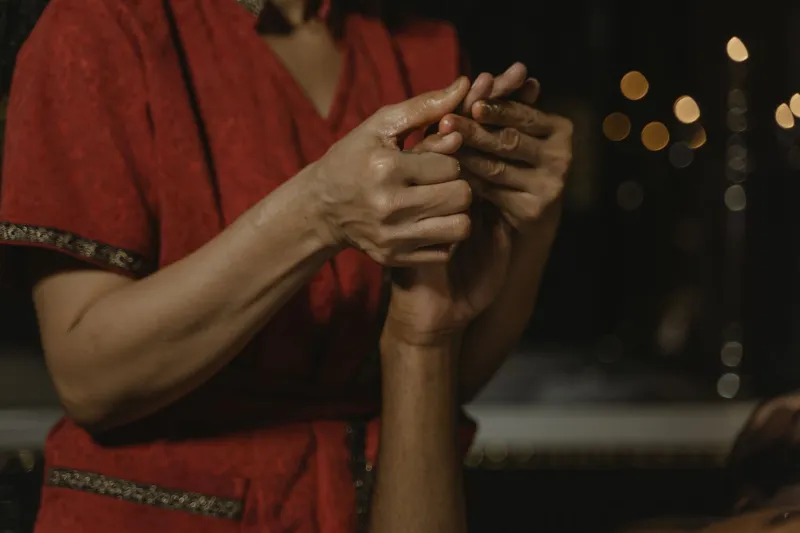
The practice is simple but specific. You warm a small amount of oil (traditionally sesame for most constitutions, coconut for those who run hot) and apply it to your entire body using long strokes on the limbs and circular strokes on the joints. The whole thing takes maybe fifteen minutes before a shower.
What's happening beneath the surface is more interesting than it sounds. The combination of warmth, rhythmic pressure, and the meditative quality of intentional self-touch activates those C-tactile fibers we mentioned. It also stimulates lymphatic flow, reduces cortisol, and — according to Ayurvedic philosophy — nourishes ojas, the subtle essence that governs vitality and immunity.
Modern research on self-compassion touch (including studies from the University of California) has found that deliberate self-touch — even just placing a hand over your heart — measurably reduces cortisol and increases feelings of safety. Ayurveda has been prescribing a full-body version of this for millennia.
If you want to start small: just do your feet. Five minutes of warm oil massage on your feet before bed is one of the most underrated sleep interventions that exists, and it costs almost nothing.
Hand Reflexology and the TCM Map You're Walking Around With
Traditional Chinese Medicine views the hands as a complete map of the body — every organ system, every meridian, accessible through specific points on your palms and fingers.
Hand reflexology, rooted in this framework, works by applying targeted pressure to these zones to move stagnant qi, reduce tension, and communicate safety to the nervous system through the hands' dense concentration of nerve endings.
The web between your thumb and index finger — the Hegu point, or LI4 — is one of the most powerful points in the entire meridian system. TCM practitioners use it to release tension, address headaches, and calm an agitated nervous system. You can stimulate it yourself by pressing firmly into that fleshy triangle with the opposite thumb and holding for thirty to sixty seconds while breathing slowly.
Do this during a stressful meeting, stuck in traffic, or at 2am when your brain won't quit. The shift is subtle but real — and it's available to you literally anywhere, at zero cost.
Another entry point: the Laogong point at the center of your palm. In Qigong practice, this point is considered a gateway for both receiving and transmitting healing energy. Simply pressing one palm's center firmly into the other and holding — while breathing into your belly — can interrupt a stress response faster than most people expect.
What Indigenous Touch Ceremonies Understood That We Forgot
Across Indigenous traditions worldwide — from the Hawaiian practice of lomi lomi massage to the communal grooming rituals of many Native American communities — touch was never private or purely individual. It was relational. It was ceremonial. It was how communities literally regulated each other's nervous systems.
Lomi lomi, practiced by Native Hawaiian healers, isn't just bodywork in the Western sense. It's understood as a spiritual conversation — a way of helping the body release old stories held in muscle and fascia, while the practitioner channels aloha (love, presence, compassion) through their hands. Recipients often describe emotional releases they didn't see coming. That's not mystical accident. That's what happens when the nervous system finally feels safe enough to let go of what it's been bracing against.
You don't need a practitioner to access this principle. What you need is intention.
The next time someone you trust offers a hug, actually receive it. Let it last longer than the socially acceptable three seconds. Notice what happens in your chest when you stop performing the hug and start experiencing it. That's your parasympathetic nervous system remembering something ancient.
Building a Daily Touch Ritual (That Doesn't Require a Partner)
One of the most persistent myths about touch deprivation is that you can only solve it with another person. You can't. Ancient traditions knew this — which is why so many of them built self-touch into daily practice.
Here's a simple framework to start with:
Morning: Before getting out of bed, place both hands flat on your belly. Feel it rise and fall with three slow breaths. This is a grounding practice used in various forms across Andean, Ayurvedic, and somatic healing traditions. It tells your nervous system: we're here, we're okay, we're starting gently.
Midday: Spend two minutes on the Hegu point (LI4) when you feel tension spiking. No explanation needed at your desk — it just looks like you're thinking.
Evening: Five to ten minutes of warm oil on your feet and lower legs. Put on something you love to listen to. Make it a ritual, not a task.
Weekly: If you have access to any form of bodywork — massage, acupressure, even a trusted friend who's willing to exchange back rubs — schedule it like you'd schedule a therapy appointment. Because physiologically, it's doing overlapping work.
Your Hands Have Always Known
There's a reason every healing tradition on earth has a touch practice at its center. It's not superstition. It's not placebo (though placebo is also real medicine, but that's another article). It's the body's oldest communication system — one that predates language, predates culture, predates every wellness trend that's going to come and go in your Instagram feed.
Your nervous system isn't asking for another supplement or a better meditation app. It's asking to be touched with intention — by you, by people who love you, by practices that have been refined across centuries of human wisdom.
Your hands are talking. It's time to listen back.