The Medicine in Your Palms: How Mudras Quietly Rewire Your Nervous System
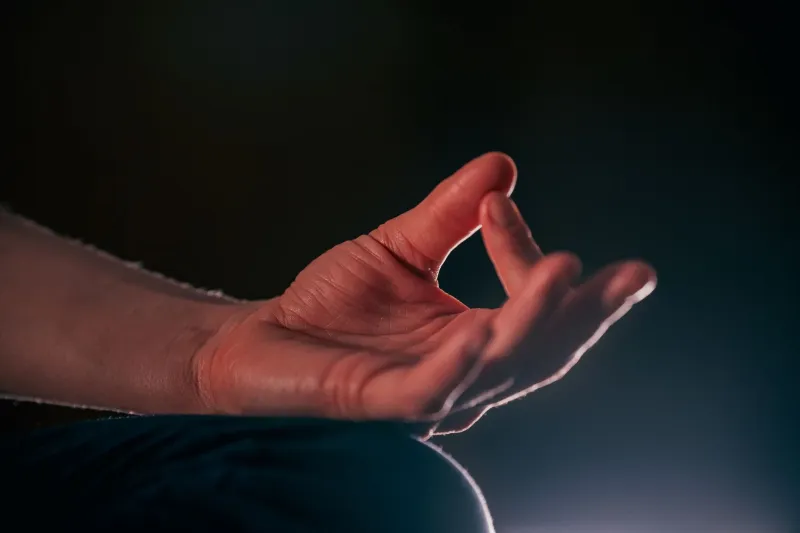
You're sitting in traffic on the 405, or waiting on hold with your insurance company, or doom-scrolling at midnight again — and your nervous system is absolutely fried. You reach for your phone. Of course you do. It's the reflex of our era.
But here's what's wild: your hands were already medicine. Long before screens, long before pharmaceuticals, long before even written language, cultures across Asia understood that specific configurations of the fingers and palms could shift something fundamental in the body. They called these positions mudras — a Sanskrit word meaning "seal" or "gesture" — and they built entire healing traditions around them.
This isn't incense-and-wishful-thinking territory. There's a growing body of physiological research suggesting that hand positions genuinely influence nerve pathways, autonomic function, and even emotional regulation. Ancient practitioners intuited something that modern neuroscience is only now catching up to.
What Mudras Actually Are (And What They're Not)
Let's clear something up right away: mudras are not magic spells. They won't manifest a parking spot or cure a chronic illness on their own. What they are is a sophisticated system of intentional body positioning — one that's been refined across thousands of years of practice in Hinduism, Buddhism, Jainism, and classical yoga.
The tradition holds that the hands are densely mapped with energy channels called nadis, and that different finger combinations create specific circuits of energy flow throughout the body. In Ayurvedic medicine, each finger corresponds to one of the five classical elements — thumb to fire, index to air, middle to space, ring to earth, pinky to water. Bringing fingers together in particular ways was believed to balance these elemental forces within the body.
Skeptical? Fair. But consider this: your hands contain more nerve endings per square inch than almost any other part of your body. They're extraordinarily well-represented in the brain's sensory cortex. And several major nerve pathways — including branches of the vagus nerve, the star of contemporary wellness science — run directly through them.
The Vagus Nerve Connection
If you've spent any time in wellness spaces lately, you've heard about the vagus nerve. It's the long, wandering nerve that connects your brainstem to your heart, lungs, and digestive system, and it's the main highway of the parasympathetic nervous system — the "rest and digest" counterpart to fight-or-flight.
Stimulating the vagus nerve is now a mainstream strategy for managing anxiety, depression, and chronic stress. Techniques like cold exposure, humming, and slow diaphragmatic breathing are all popular vagal toning methods. What's less discussed is that the hands play a role here too.
Research on acupressure points — many of which overlap with mudra contact points — has shown measurable effects on heart rate variability (HRV), a key marker of vagal tone. A 2019 study published in the Journal of Alternative and Complementary Medicine found that specific hand-based acupressure reduced cortisol levels and improved HRV in participants with generalized anxiety. That's not nothing.
When you hold a mudra, you're applying gentle, sustained pressure to specific nerve endings and acupressure points. You're also giving your hands something intentional to do — which interrupts the anxious, aimless fidgeting that keeps the nervous system on edge.
Four Mudras Worth Actually Using
Here's where this gets practical. You don't need to sit in lotus pose on a meditation cushion to use these. You can do them in your car (parked, please), at your desk, during a meeting that could've been an email, or lying in bed at 2am when your brain won't quit.
Gyan Mudra — For Clarity and Focus Touch the tip of your index finger to the tip of your thumb, keeping the other three fingers extended and relaxed. This is probably the most recognized mudra in the West, often associated with meditation imagery. In yogic tradition, it's said to stimulate the air element and enhance mental clarity. Practically speaking, the gentle finger-tip pressure engages sensory receptors and creates a subtle proprioceptive feedback loop that can anchor a wandering mind. Try it during your next work sprint.
Apan Vayu Mudra — For Anxiety and Heart Support Fold your index finger to touch the base of your thumb. Then bring your middle and ring fingertips to touch your thumb tip, while the pinky extends outward. This one looks more complex but becomes second nature quickly. Traditional Ayurvedic texts refer to it as the "heart mudra," used for emotional overwhelm and cardiovascular support. Modern practitioners often report a noticeable calming effect within a few minutes — likely due to the vagal stimulation from the combined contact points.
Dhyana Mudra — For Stillness and Emotional Reset Rest one hand in your lap, palm up. Place the other hand on top of it, also palm up, with the thumbs lightly touching to form an oval shape. This is the classic meditation mudra seen in Buddhist iconography worldwide. The bilateral, symmetrical positioning creates a sense of containment — literally and neurologically. It signals to the brain that nothing needs to be done right now. For people who struggle to settle during meditation, starting with this mudra can be the difference between spinning and actually landing.
Shuni Mudra — For Patience and Creative Blocks Touch the tip of your middle finger to the tip of your thumb, extending the others softly. In traditional practice, the middle finger governs the space element and is associated with breaking through stagnation. If you've been staring at a blank page, a stuck project, or a decision you can't make, this one is worth a ten-minute experiment. It's not mysticism — it's giving your hands a focal point so your prefrontal cortex can stop white-knuckling and actually think.
The Real Reason These Work
Here's the honest, non-mystical explanation for why mudras tend to produce real results: they combine several well-documented therapeutic mechanisms simultaneously.
First, they require you to slow down and pay attention to your body — which is itself a form of mindfulness with measurable stress-reduction effects. Second, they engage the hands in a way that activates sensory processing and can interrupt anxious thought loops. Third, sustained, gentle pressure on specific hand regions affects the peripheral nervous system in ways that researchers are still mapping but are increasingly taking seriously.
And fourth — maybe most importantly — they're a ritual. They mark a moment as different. They tell your brain: this is the part where we shift gears. In a culture where transitions are frictionless and everything bleeds into everything else, that signal matters enormously.
Starting Where You Are
You don't need to overhaul your life to try this. Pick one mudra — Gyan is the easiest entry point — and hold it for five minutes tomorrow morning before you check your phone. Just five minutes. Notice what shifts.
The ancient practitioners who developed these systems weren't working with neuroscience terminology, but they were working with the same human nervous system you have right now. They noticed patterns, refined techniques over generations, and passed down what actually worked.
Your phone will still be there. But so will your hands — and they've been holding medicine this whole time.